
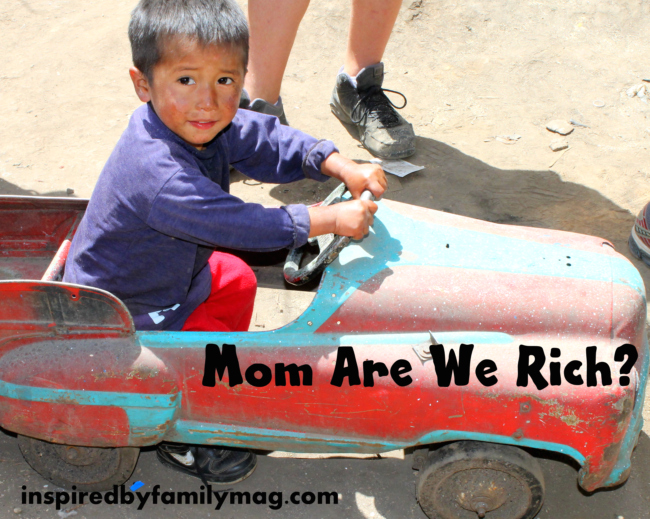
With the season of giving here at our doorstep this is a great time to talk about wealth, money and poverty with our kids. We have so many teachable moments this time of the year to discuss this topic, “Mommy are we rich?” Last year, we had a neat opportunity when we literally had “the season of giving” at our door step. When our doorbell rang Christmas morning you can click here for the story. Enjoy this wonderful perspective from our newest contributor, Beth. We are so excited to have her on our team!

Contributing Writer: Beth D Saavedra
“Mom, we’re rich, right?” How would you answer that question?
Probably you’re wondering whether I am rich, and I would answer, “How do you define rich?”
By this fun Wall Street Journal calculator, my family falls in the bottom half of the U.S. based on our income. But that number is too simple, since it doesn’t factor in household size (there are six of us), or net worth (we don’t own a home, but we do own our car), or debts (we try not to carry a balance on our credit card, but don’t always succeed). And then there’s this calculator of how rich we are compared to the rest of the world, which says our family is in the richest 17% of the world’s population. Quite a step up from our U.S. percentage!
Defining wealth is a slippery business. And it gets slipperier when we realize that there are materially poor people who consider themselves rich, just as there are people with six figure incomes who lose sleep at night over finances.
Maybe the point is not to fixate on a number, but to see how we can shape our (and our children’s) attitudes about money.
Do we even talk about money with our kids? A recent study conducted for the American Institute of CPAs shows most parents would rather talk to their kids about practically any topic other than money. Could the first step to a healthy view of money be to break the taboo and actually talk to our children about where we are at financially? Can we start explaining to them some of our purchasing decisions?
Our actions tell a more powerful tale than any words about money we might say to our kids. When money is tight, are my children learning from me that worry and complaining are the normal response? When we have extra, do they automatically think about whom they can share the abundance with?
Sometimes I feel poor (like when the only way I can buy groceries at the end of the month is to use my credit card). Sometimes I feel rich (like when I think about how many family members, church friends, and the greater community would be ready in a second to lend us a hand, if we needed a loan). Either way, I want my kids to know that gratitude should be our default response to life.
So how did I respond to my son’s question? “Honey, we are rich. We don’t have everything we want, but we have so much more than we need. Let’s thank God for some of your favorite things, right now.” And we did.
How would you respond?
Also, from Beth: Wasted Thoughts on Dissatisfaction with My Body
Beth Saavedra is an avid fan of her husband, the band U2, chocolate and the Bible. She loves her four kiddos more than life itself. Beth makes her messy, friend-filled home in Ecuador. You can find her at http://saavedrastories.blogspot.com.






What a great post on a difficult topic! I do think it’s important to teach kids financial skills so maybe this question, Mommy are We Rich, can be redirected into that to include working hard, saving, and keeping to a budget.
Pragmatic Mom, Most definitely great points to highlight when discussing this topic.
My teen and above children take a global perspective on where our family is at financially and feel that we are very rich.
Mary
Mary, Yes a global perspective is important and we are constantly reminded of how “rich” we are when we see street kids with shoes that don’t fit and are falling apart.
My parents were smart about all this. They always took us shopping so we could learn good consumerism habits including sticking to a budget, comparision shopping, and making wise choices. They also answered questions using phrases like “out of our price range”, “put it on the shopping list”, “maybe for your birthday”, “that’s something we’ll have to save for” or “that’s too extravagant” which gave us a sense of whether our childish wishes were in line with their financial reality. But they did NOT give us actual numbers. to this day I hve no idea how much the gas bill or the mortgage were. I have no idea how much money they earned at work, what their taxes were, or how much they had saved/invested. Which is good. Kids might not keep that info confidential and the last thing you need is people judging you or making assumptions about you once they know your actual numbers.
The home group my son and I are in did Andy Stanley’s “Lo$t” series over the summer. I hope that it opened his eyes some to how important financial decisions are. He’s 16 now, and I hope to open up an account for him soon to start teaching him basic financial principles. We have had a lot more talks about finances over the last six months since I became a single mom. I want him to realize that even though we don’t have a lot, we have everything we need and God will always provide. But we have to do our part to make smart decisions.
[…] Talking About Money With Our Kids- Wealth and Kids December 1, 2012 […]
[…] Talking About Money With Our Kids- Wealth and Kids (inspiredbyfamilymag.com) […]